

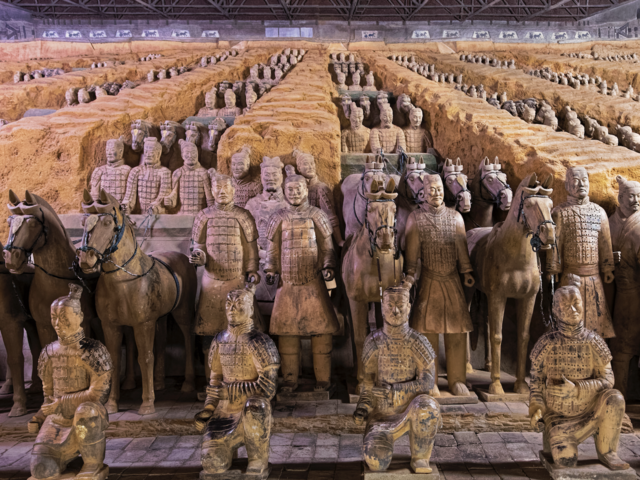
You never forget the moment you come face-to-face with one of the thousands of Terracotta Warriors underground in Xi’an, China. As ancient wonders of the world go, these may make the strongest impression even on an experienced traveler like me.
I think it’s because, unlike the vast, mystical monuments like Egypt’s pyramids or Machu Picchu, the warriors are so… personal. On a human scale, individually, even if the archaeological site is breathtakingly vast. And you also feel like you are looking at recognizable fellow people – not mythological gods or legendary beasts - eye to eye. With a quick change of clothes, he could be the guy sitting beside you on the plane!
In 1974, farmers digging a well accidentally uncovered the location of a vast clay army guarding the underground tomb of China’s first emperor, Qin Shi Huang.
Today, the site, known as the Terracotta Army, is among the most astonishing historical attractions in the world. Millions of travelers explore the enormous excavation halls each year, contemplating the silent ranks of soldiers who have been standing guard since before 200 BCE.
Think about it. They’ve been here for over 2200 years! That means they are:
- about the same age as the pyramids of Giza in Egypt,
- more than two centuries older than the Colosseum in Rome,
- nearly 1,700 years older than Machu Picchu in Peru, and
- had been standing at attention for a millennium before Mexico’s Chichen Itza was built.
And that’s not even the most extraordinary fact about the largest burial site on earth!
Every Warrior Has a Different Face
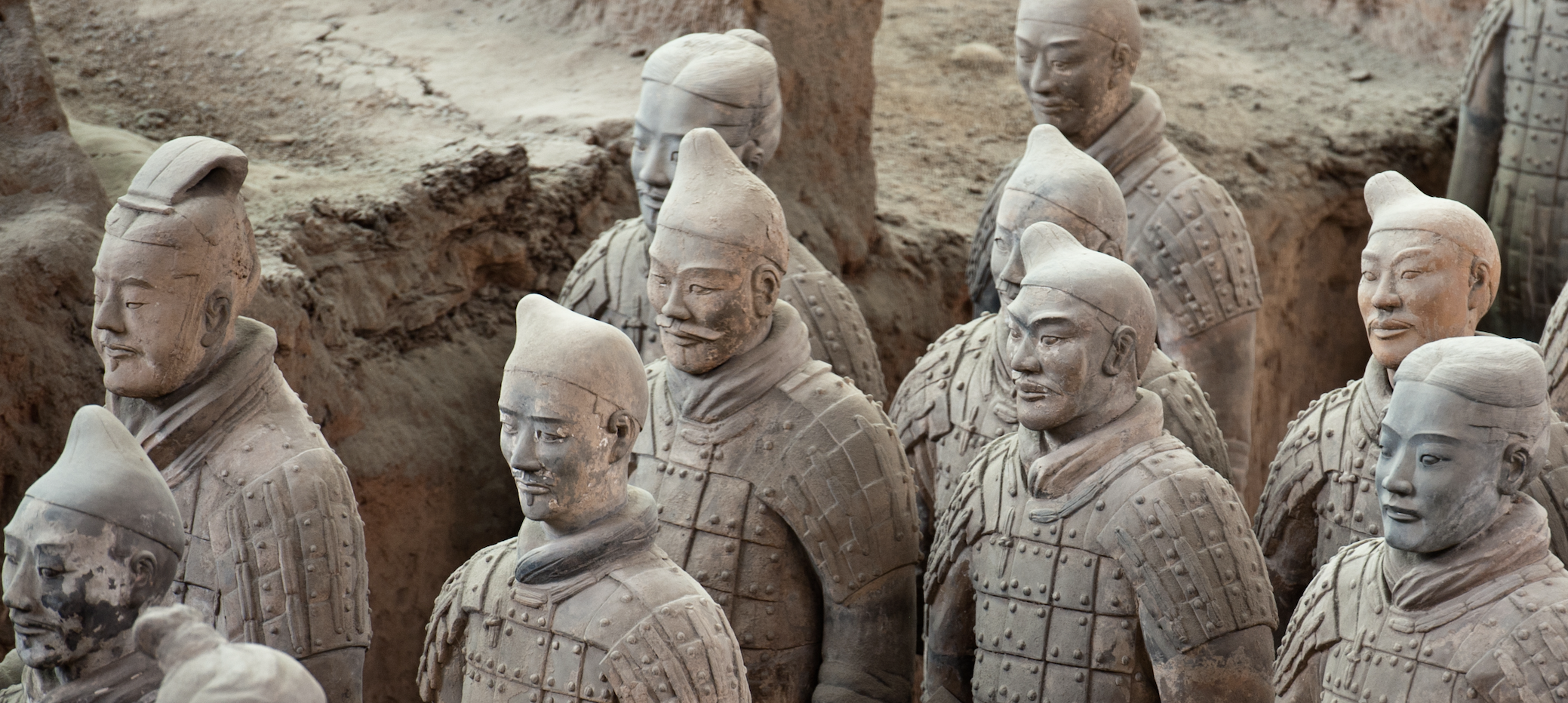
Look closely, and you’ll realize: no two warriors look exactly alike. Rather than a burial installation, it feels like a busy airport or stadium lineup!
Astonishingly, ancient craftsmen achieved this incredible individuality using a modular system of sculpted features—ears, noses, brows, moustaches, and hairstyles—that could be combined in different ways to create unique faces. (Like an early Mr. Potato Head!) Some warriors look youthful, and others, much more weathered; some are clean-shaven, others wear thick beards; some have stern, and others rather friendly expressions.
The result feels uncannily lifelike.
The Warriors Are Surprisingly Tall
Many statues stand between 5'9" and 6'5" (175–195 cm) tall—considerably taller than the average height of people during the Qin dynasty, but very familiar to us today.
They Were Originally Fully Armed
But they didn’t really feel like ordinary people – instead, robust and fierce warriors. Excavations uncovered thousands of genuine bronze weapons among the soldiers—swords, lances, crossbows, arrowheads, and spear tips. Many remain astonishingly sharp even after more than 2,000 years underground.
Some blades had a chromium-rich coating that protected them from corrosion, with technological sophistication centuries ahead of its time.
In other words, the emperor’s afterlife army wasn’t ceremonial – it was battle-ready.
The Army Once Blazed With Color
The statues we see today appear in shades of clay, but originally, they were brilliantly pigmented in reds, greens, purples, blues, and flesh tones, then coated in lacquer.
Unfortunately, exposure to air after excavation almost immediately caused the lacquer to crack and flake. Within minutes, many figures lost the vivid hues they had worn for two millennia.
Today, archaeologists use advanced preservation techniques to stabilize pigment on newly uncovered warriors.
They’re One Part of a Vast Underground World That Has Yet to be Fully Revealed
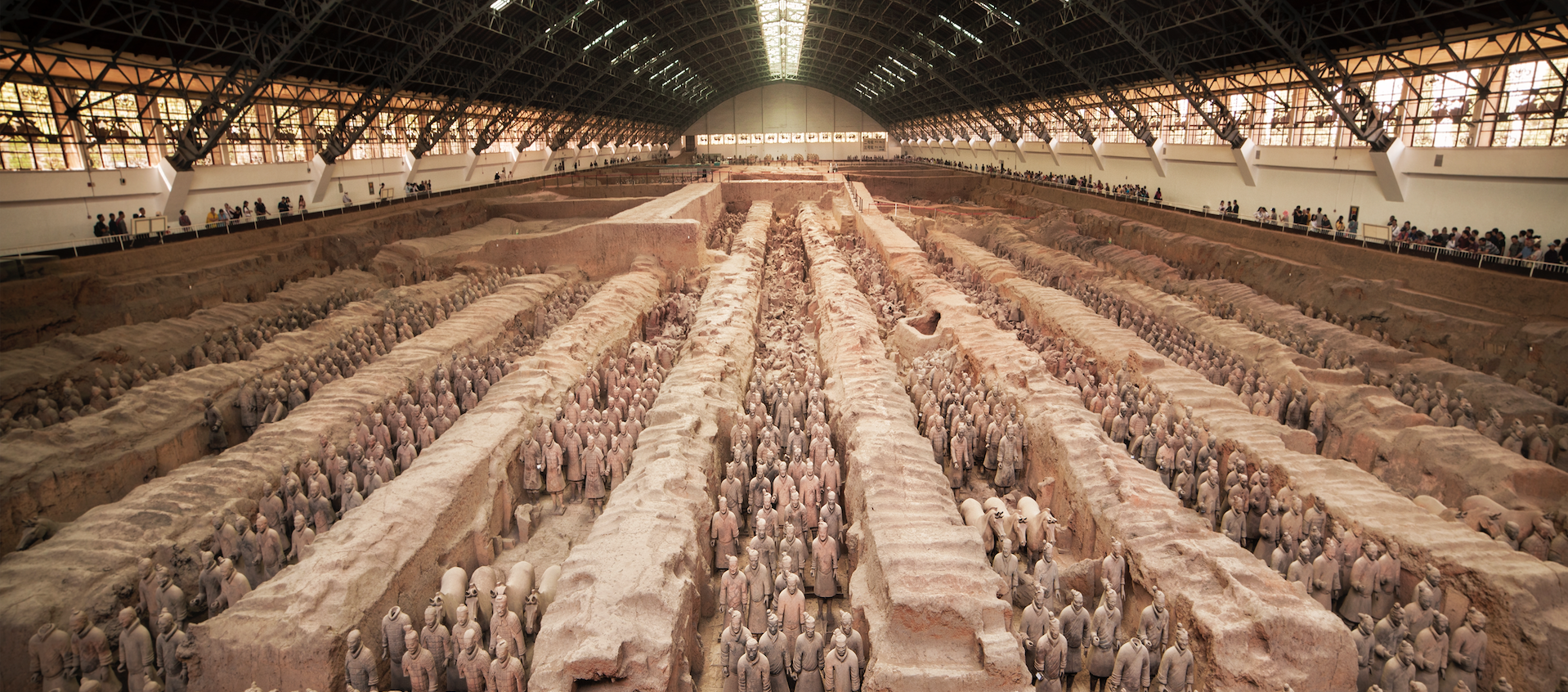
So far, more than 8,000 warriors, along with hundreds of horses and chariots, have been identified. But the Terracotta Warriors represent just a single section of an immense burial complex.
The mausoleum stretches roughly 56 square kilometers – 22 square miles or 14,000 acres! Archaeologists believe it includes palaces, government offices, stables, acrobats, musicians, and entire landscapes recreated underground.
Remarkably, the central tomb itself has never been opened.
And large sections of the complex remain untouched as scientists wait for better conservation methods before opening additional pits.
Which means the Terracotta Army is still revealing its secrets.
START YOUR TRIP!
By: Lynn Elmhirst, travel journalist and expert
Images: Getty
All rights reserved. You are welcome to share this material from this page, but it may not be copied, re-published, broadcast, rewritten, or redistributed.